

If your business is excellent but difficult to find online, Google has no way to give you credit for being excellent.
That is the slightly rude truth.
Local customers are searching for plumbers, cleaners, contractors, consultants, restaurants, repair shops, and every other kind of service business right now. They are checking Google Maps, comparing profiles, scanning reviews, looking at photos, visiting websites, and increasingly asking AI-powered search tools for recommendations.
The businesses that get found are not always the biggest businesses. They are the businesses that make their information easy to understand, easy to trust, and easy to act on.
That is what we call the Google Visibility Engine.
It starts with a strong Google Business Profile, connects to a consistent presence across Google, Meta, WhatsApp, and your website, and eventually feeds a lead capture and follow-up system that helps turn attention into paying customers.
A listing that exists is not the same as a listing that works
Most local businesses have some kind of Google listing. The problem is that many listings are half-finished digital leftovers:
- The wrong business category
- Outdated hours
- No service details
- A handful of old photos
- An incomplete description
- An address or phone number that does not match other platforms
- Questions sitting unanswered
- A website link that leads to a confusing or outdated page
That listing technically exists. But it is not doing much heavy lifting.
A working Google Business Profile should quickly answer the questions a potential customer is already asking:
- What do you do?
- Where do you serve?
- Are you open?
- Can I trust you?
- What does your work look like?
- How do I contact you?
- What happens after I click?
Google itself says local visibility is influenced primarily by relevance, distance, and prominence. In plain English, Google wants to show businesses that match the search, are appropriately located, and appear established and trustworthy.
Your profile is one of the clearest ways to communicate all three.
The foundation: Google Business Profile optimization
A strong profile begins with accurate, complete information. That sounds basic because it is basic. It is also where many businesses quietly lose opportunities.
Choose the right categories
Your primary category tells Google what your business fundamentally is. Choosing “Business” or the broadest available option is not helpful if a more specific category describes your work.
Relevant secondary categories can add context, but categories should describe what you actually do. Stuffing your profile with unrelated options is not a clever shortcut. It is more like putting every label in the spice cabinet on one jar and hoping dinner understands.
List your services clearly
Add the services customers search for, using plain language. Include descriptions where available and explain the practical outcome.
For example, “water heater repair” is clearer than “residential plumbing solutions.” “Tax preparation for small businesses” is more useful than “financial services.”
This is important for both human visitors and the systems interpreting your business information.
Keep hours accurate
Your regular hours, holiday hours, and appointment details should be current. An incorrect “Open” or “Closed” status is more than a minor inconvenience. It can make a customer choose someone else before they ever visit your website.
Use photos that prove you are real
Photos should show the actual business, team, work, products, service area, vehicles, finished projects, or customer-facing environment.
People want evidence. They want to know what they are getting into before they call. A clean, current photo library helps your business feel present instead of abandoned in the internet wilderness.
Complete reviews and Q&A responsibly
Reviews contribute to the overall trust picture customers see when comparing businesses. Thoughtful owner responses also show that a real person is paying attention.
The Q&A section matters for the same reason. Common questions about service areas, appointments, parking, pricing ranges, or availability can be answered before they become reasons not to contact you.
Google’s own guidance recommends keeping business information complete and current, responding to reviews, and adding photos and videos to help customers understand what you offer. You can review Google’s recommendations in its guide to improving local ranking.
Your business should look like one business everywhere
Google is important, but it is not the only place customers check.
Many people move between Google, Facebook, Instagram, your website, and WhatsApp before they contact a business. If your name, phone number, service area, hours, or description changes from one platform to another, customers may wonder whether they have found the right company.
That inconsistency also makes it harder for search systems and AI answer tools to confidently connect the dots.
Your business information should align across:
- Google Business Profile
- Your WordPress website
- Facebook and Instagram
- WhatsApp Business
- Relevant local and industry directories
- Email signatures and other public contact points
This does not mean every platform needs identical wording. It means the important facts should agree.
The business name should be recognizable. The phone number should be current. The service area should make sense. The website should point to the same business. Your visual identity should also feel connected, so customers do not feel as if they have accidentally crossed into three unrelated companies.
What local search and AI answers are looking for
Search is no longer limited to ten blue links.
Customers may see a Google Maps result, a local pack, a business panel, an AI-generated summary, or a recommendation assembled from several sources. These systems do not rely on one magical field in your profile. They look for connected signals.
Those signals can include:
- Your Google Business Profile information
- Your website content
- Service and location pages
- Reviews and business responses
- Public business directories
- Local mentions and links
- Social profiles
- Contact details and hours
- Clear descriptions of your expertise
The exact formulas are not public, and nobody can honestly promise a guaranteed position. Google specifically states that businesses cannot pay for a better local ranking.
What you can do is make your business easier for systems to understand and easier for customers to trust.
That means writing clear service descriptions, maintaining useful website content, keeping information consistent, and showing evidence that your business is active and legitimate.
This is the practical side of online visibility for local business. It is not about chasing every new platform. It is about building a reliable information footprint.
Visibility only matters when it leads somewhere
A customer finding your business is a win.
A customer finding your business and having an obvious next step is much better.
Your Google profile should connect people to a useful destination:
- A focused service page
- A quote request form
- A booking page
- A phone call
- A WhatsApp conversation
- A simple contact page
This is where visibility becomes lead generation for small business owners.
If someone clicks from Google and lands on a page that is slow, vague, or difficult to use, the visibility engine has done its job only halfway. You attracted attention, then left the visitor standing in the lobby with no receptionist.
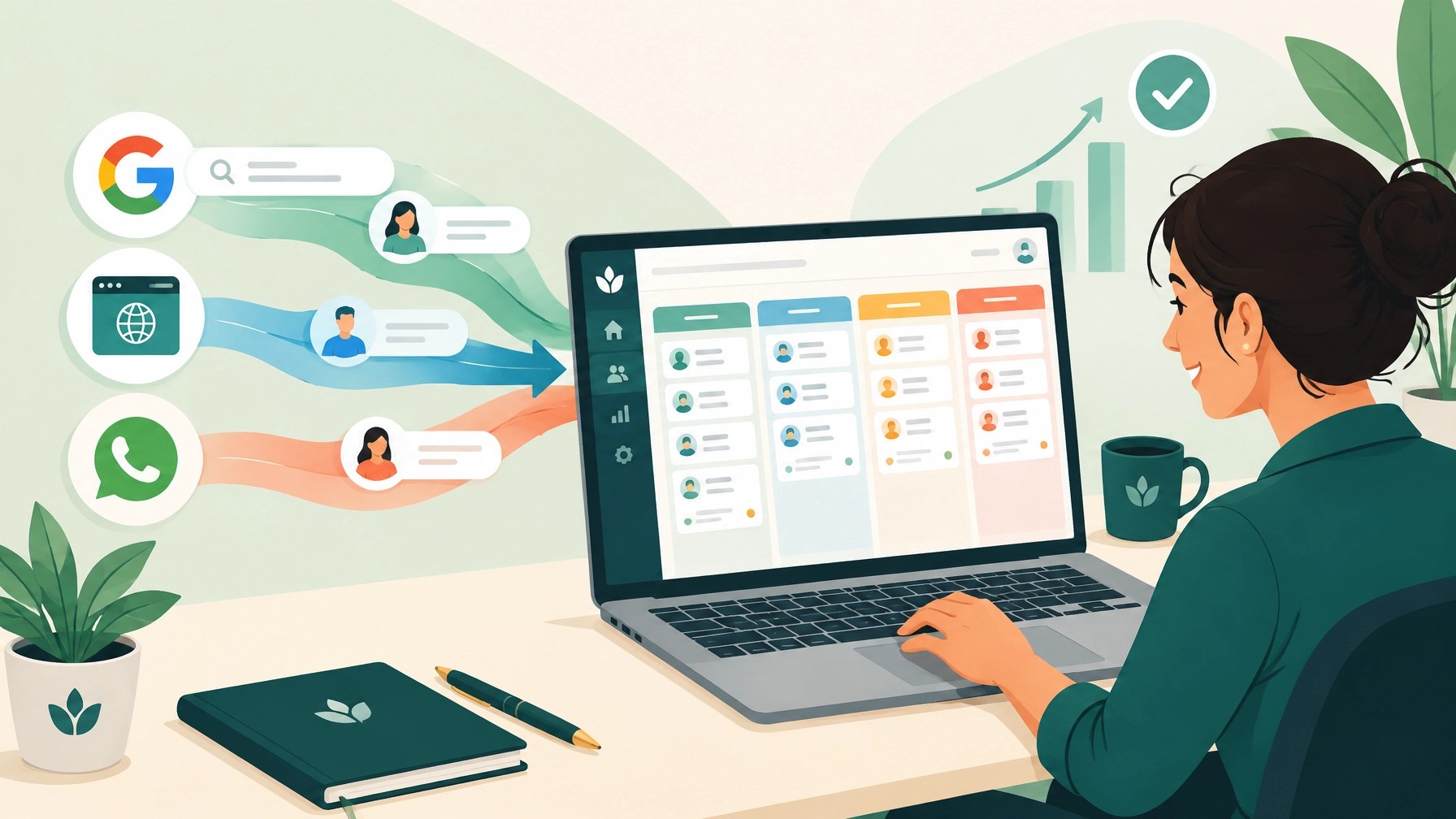
A practical lead capture system gives that visitor a clear path forward. It can collect the basic details you need, identify the service they are interested in, and move the inquiry into a process your team can actually manage.
Add Zoho CRM when you are ready
Not every business needs a complicated automation system on day one.
That is why a modular approach makes sense.
Start with visibility. Make sure people can find you and understand what you do. Then add lead capture when inquiries begin arriving. After that, connect those leads to a Zoho CRM pipeline so you can track what happens next.
A simple pipeline might show:
- New inquiry
- Contact attempted
- Consultation or estimate scheduled
- Proposal sent
- Won or lost
- Follow-up needed
From there, small business marketing automation can handle practical follow-up tasks, such as sending confirmation messages, reminding you about unanswered leads, or keeping prospects from disappearing into the digital fog.
The goal is not to replace the personal side of your business. The goal is to make sure good opportunities do not get forgotten while you are serving customers, driving between jobs, or trying to locate the one invoice that has mysteriously entered another dimension.
A simple roadmap for building your visibility engine
You do not need to purchase every marketing service at once. A sensible roadmap can grow with your business.
Module 1: Visibility
- Claim and verify your Google Business Profile
- Correct your categories, hours, services, photos, and business details
- Align information across Google, Meta, WhatsApp, and your website
- Make sure your WordPress site has clear local service content
Module 2: Lead capture
- Add a focused contact or quote form
- Create a clear call-to-action from your profile and website
- Route inquiries to the right person
- Make it easy for customers to call or start a WhatsApp conversation
Module 3: CRM organization
- Build a Zoho CRM pipeline
- Track every inquiry from first contact to final outcome
- Add fields for service type, location, timing, and lead source
- Create a shared view of what needs attention
Module 4: Follow-up automation
- Send confirmations
- Create reminders for open opportunities
- Automate appropriate follow-up messages
- Monitor which sources are producing real conversations
This structure lets you begin with what you need today and add capability as your business grows.
Local SEO without the agency fog
You may have searched for local SEO services for small business and found packages involving long contracts, vague deliverables, and monthly reports that appear to have been written by a committee of robots.
At Amaryllis Digital Studio, we take a different approach.
We focus on practical systems for small businesses:
- Transparent fixed pricing
- Small-business budget focus
- WordPress-ready delivery
- Zoho CRM specialization
- Modular services instead of oversized retainers
- Clear deliverables you can understand
We help build the foundation first, then add lead capture and automation when the timing makes sense.
Your business does not need more noise. It needs a connected system that helps customers find you, trust you, and take the next step.
Ready to make your business easier to find? Visit Amaryllis Digital Studio or use our contact page to start a conversation about your Google visibility, lead capture, and CRM roadmap.
Leave a Reply