

0. EXECUTIVE SUMMARY
Lead management failure occurs when inbound inquiries are not captured, processed, or followed up through a standardized system. Small business owners often rely on manual data entry or memory. These methods are prone to high error rates and delay response times. Implementation of three specific automations eliminates these failure points.
1. THE PROBLEM: SYSTEMIC LEAD FRAGMENTATION
Manual lead management is non-scalable. Data fragmentation occurs when leads arrive from multiple sources including Google Business Profiles, Meta ads, website forms, and WhatsApp. Without a centralized system, 35–50% of leads are lost due to slow response or incomplete data capture.
1.1 INEFFICIENCY DATA
- Response Delay: Waiting 60 minutes to contact a lead reduces conversion probability by 80%.
- Capture Loss: 25% of leads are never recorded in a CRM when manual entry is required.
- Follow-Up Failure: 70% of leads require more than five touchpoints to convert; most manual processes stop after two.
2. AUTOMATION 01: CENTRALIZED DATA CAPTURE
Centralization is the process of funneling all lead sources into a single source of truth. For small businesses, Amaryllis Digital Studio recommends using Zoho CRM pipelines to automate this ingestion.
2.1 FUNCTIONAL REQUIREMENTS
- API Integration: Connect Meta Lead Forms and Google Business Profile messaging directly to the CRM.
- Web-to-Lead Forms: Embed standardized lead capture forms on WordPress websites to eliminate email-only notifications.
- Field Mapping: Ensure all metadata: such as lead source, time of inquiry, and service interest: is mapped to the CRM record automatically.
2.2 IMPACT ON OPERATIONS
- Elimination of Duplication: CRM logic identifies existing contacts to prevent duplicate records.
- Data Integrity: Records are complete upon arrival.
- Visibility: Business owners view all active inquiries in one dashboard, reducing search time for contact information.
3. AUTOMATION 02: INSTANT RESPONSE NOTIFICATION
Speed-to-lead is the primary predictor of conversion success. Automation 02 triggers an immediate touchpoint upon lead creation. This confirms receipt and initiates the sales conversation without human intervention.
3.1 TECHNICAL SPECIFICATIONS
- Trigger: New lead creation in Zoho CRM.
- Action 1 (Internal): Push notification to the owner's mobile device via the CRM app or WhatsApp integration.
- Action 2 (External): Automated SMS or WhatsApp message sent to the lead confirming the inquiry and stating a specific timeframe for personal follow-up.
3.2 SYSTEM BENEFITS
- Immediate Engagement: Meets the "5-minute rule" for lead qualification.
- Expectation Management: Informs the prospect that their data has been received, preventing them from contacting competitors.
- Operational Readiness: Owners are alerted via lead management systems even when they are not actively monitoring their inbox.
4. AUTOMATION 03: SEQUENCED FOLLOW-UP NURTURING
Most leads are not ready for immediate transaction. Failure to nurture "cold" leads results in wasted advertising spend. Automation 03 uses multi-step workflows to maintain brand presence over time.
4.1 WORKFLOW ARCHITECTURE
Amaryllis Digital Studio utilizes a multi-step CRM automation structure, typically involving 3 workflows with 4 distinct steps each:
- Day 1: Educational content regarding the service.
- Day 3: Proof of results or case study link.
- Day 7: Direct call-to-action for a consultation.
- Day 14: Final check-in or "break-up" message.
4.2 LOGICAL BRANCHING
The system updates based on lead behavior:
- Outcome A (Engagement): Lead replies or clicks a link. The automation pauses, and a task is created for a manual call.
- Outcome B (No Engagement): The lead continues through the scheduled sequence.
5. TECHNICAL IMPLEMENTATION STEPS
Implementation must follow a modular approach. Organizations should deploy systems in the following order:
- Audit Infrastructure: Identify all current lead entry points (GMB, Meta, Website).
- Configure CRM: Set up Zoho CRM pipelines tailored to specific service categories.
- Deploy Capture Forms: Replace static contact forms with CRM-connected capture systems.
- Build Workflows: Program the triggers and delays for instant response and long-term nurturing.
- Test Logic: Execute test submissions to verify data flow and notification delivery.
6. CONCLUSION
Lead management failure is a technical deficit, not a marketing deficit. Small business owners who implement centralization, instant response, and sequenced nurturing reduce lead loss and increase qualification rates. These CRM automations allow for business growth without a proportional increase in administrative workload.
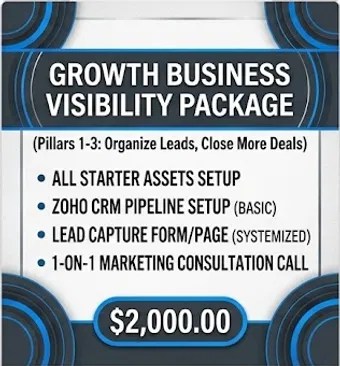
Master your lead management with the Growth Package
Leave a Reply